
Transfer switches · 100 to 4000 A
Generator transfer switch installation, matched to how you'll actually use the power.
A transfer switch connects a generator to your electrical system without backfeeding the utility. An automatic transfer switch (ATS) does it on its own for a standby generator; a manual switch or listed interlock does it by hand for a portable. Size and type depend on your service amperage and what you want backed up.
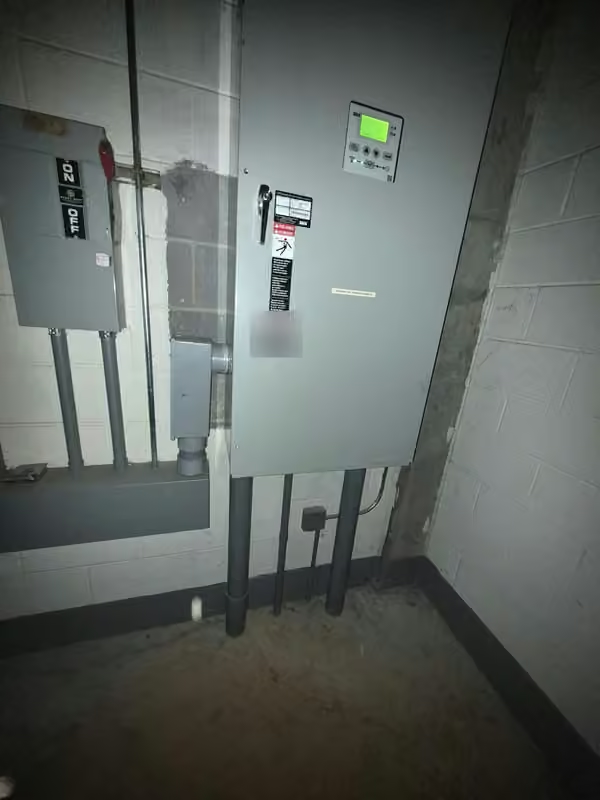
| Option | Best for | How it transfers | What it covers |
|---|---|---|---|
| Service-rated ATS | Whole-home standby | Automatic, seconds after an outage | Every circuit, with load management on large loads |
| Non-service-rated ATS | Essential-circuit standby | Automatic | A subpanel of selected circuits |
| Manual transfer switch | Portable generator | You start the generator and throw the switch | 6 to 12 selected circuits |
| Breaker interlock + inlet | Portable generator on a budget | Manual, at the main panel | Whatever you switch on, within the generator's rating |
| Commercial ATS / bypass-isolation | Emergency and standby systems | Automatic, with maintenance bypass | Feeder-level, per NEC 700/701/702 |
Transfer switch questions
Do I need an automatic transfer switch?
For a standby generator that starts on its own, yes. The automatic transfer switch watches utility voltage, starts the generator, and moves your loads over, while keeping the generator from backfeeding the utility lines. Under NEC 702.4, an automatic system has to be sized for the full load it can transfer, or use load management that sheds big loads like the AC. More on transfer switch installation.
What's the difference between a service-rated and a non-service-rated transfer switch?
A service-rated switch includes the main disconnect, so it installs between the meter and your panel and transfers the whole house. A non-service-rated switch installs after the main breaker, usually feeding a subpanel of selected circuits. On newer homes, an outdoor service-rated switch can also serve as the emergency disconnect that NEC 230.85 requires on one- and two-family dwellings.
Can I use a transfer switch with a portable generator?
Yes. A manual transfer switch or a listed breaker interlock kit with a generator inlet box lets you plug a portable generator in safely and run chosen circuits. It's the lowest-cost legal way to use a portable, and it prevents backfeed that can injure line workers. Never use a double-ended cord into an outlet.
How much does a transfer switch installation cost?
HomeAdvisor lists manual transfer switches at $500 to $2,000 and automatic transfer switches from $2,000 up, with the high end of its range covering large commercial gear (HomeAdvisor, updated June 19, 2026). A residential 200 A service-rated ATS installed is usually part of the generator proposal rather than a separate job.
What size transfer switch do I need?
Match the switch to the service it's transferring. A whole-home install on a 200 A service uses a 200 A service-rated switch. Larger homes with 320/400 A services use a 400 A switch or two 200 A switches. Commercial switches are sized to the feeder and the fault current available at the point of installation.