
Home standby generators · 10 to 48 kW
Home generator installation, whole-home or essentials, done once and done right.
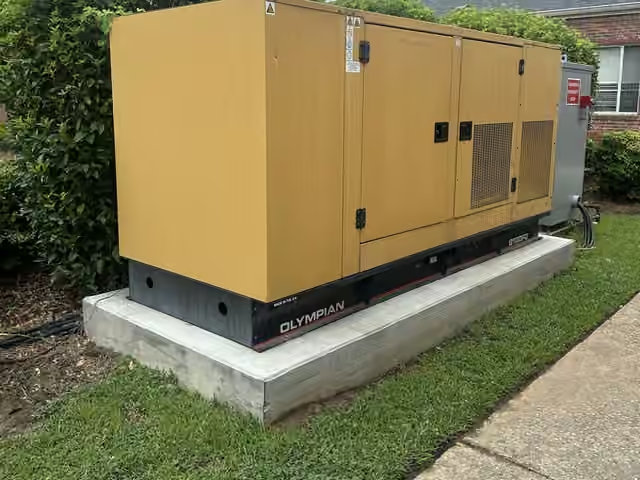
A home standby generator sits outside on a pad, runs on natural gas or propane, and starts by itself within seconds of an outage through an automatic transfer switch. Most homes need 20 to 26 kW for whole-home coverage with load management. Installation takes 1 to 3 days on site after permits.
What's in a home installNEC 702
- Generator
- Air-cooled · 22–26 kW
- Transfer switch
- 200 A service-rated ATS
- Load shed
- AC compressor, range
- Pad
- Composite or poured
- Fuel
- NG or LP · pressure tested
- Clearance
- Per listing + NFPA 37
- Startup
- Load test + outage sim
Whole-home or essential circuits?
Essential circuits means a smaller transfer switch fed from a subpanel: refrigerator, sump or well pump, furnace blower, lights, internet and a few outlets. It's the lower-cost option and usually lands at 10 to 14 kW, more if you want one AC on it.
Whole-home means a service-rated transfer switch at the meter, so every circuit is covered and load management keeps the big loads from starting at the same moment. On most 200 A homes this is the better value per dollar, because the switch replaces work you'd otherwise do on a subpanel.
If you have two AC systems, a heat pump with electric strips, an EV charger or an all-electric kitchen, tell us. Those decide the size more than square footage does.
Natural gas or propane
Natural gas is the default where it's available: unlimited run time and nothing to refill. The gas utility has to confirm the meter can carry the generator plus your furnace, water heater and range at the same time. When it can't, the utility swaps the meter or raises delivery pressure, and that request goes in with the permit.
Propane works anywhere. The tank is sized for how many days you want to run, and its placement has its own setbacks from the house and property lines.
How it gets installed
What happens between "yes" and the first outage.
Load review and site check
We start from your panel schedule, AC tonnage, fuel and photos of the meter, panel and yard. That tells us the kW size, the transfer switch type and where the unit can legally sit.
Itemized proposal
One price, broken out: generator, transfer switch, pad, electrical, gas or propane piping, permits, startup. The installing contractor and license numbers are on it.
Permits and utility coordination
Electrical and mechanical permits are pulled, and the gas utility is asked to confirm the meter can carry the added load. This step sets the calendar more than anything else.
Install day
Pad set, unit placed, transfer switch and conduit run, gas or propane line piped and pressure tested. Most homes are 1 to 3 days on site.
Inspection, startup and walkthrough
The inspector signs off, the unit is started and run under load, the weekly exercise is set, and you see a real outage test before we leave.
Home generator questions
How much does it cost to install a whole-home generator?
HomeAdvisor's 2026 data puts a 20 to 24 kW unit at $5,000 to $6,500 for the equipment, with installation labor of $1,500 to $5,000 on top, plus permits, a pad and fuel piping (HomeAdvisor, updated June 19, 2026). Larger whole-home units (26 to 48 kW) run $6,500 to $21,000 for the equipment alone. Your number depends mostly on generator size, the distance from the unit to the gas meter and electrical panel, and whether the gas meter or electrical service needs an upgrade.
What size generator do I need for my house?
Most single-AC homes of 2,000 to 3,000 square feet land at 20 to 26 kW when the AC and large appliances are load-managed. Two AC systems, a heat pump with electric backup strips, or an all-electric house push it into the 26 to 48 kW range. A load calculation from your panel and AC nameplates decides it. Our sizing calculator gives a starting range.
Should my generator run on natural gas or propane?
If natural gas is on the street, use it: no tank, no deliveries, and run time is limited only by the utility supply. The catch is volume. A 22 kW air-cooled unit can burn roughly 300 cubic feet of gas per hour at full load, more than some residential meters are set for, so the gas utility has to confirm the meter. Propane works anywhere but needs a tank sized for how long you want to run.
How close to the house can a standby generator go?
It depends on the unit's listing. Many air-cooled home units are tested and listed to sit 18 inches from the wall, but they still need 5 feet from windows, doors, vents and other openings, plus front access for service. Liquid-cooled and commercial units usually need more. The manufacturer's installation manual and NFPA 37 set the numbers, and local code can add to them.
Will a standby generator run my central air conditioner?
Yes, if it's sized for it. Starting current is the hard part, not running load: a compressor can pull several times its running amps for a moment. A soft-start kit on the AC, load management in the transfer switch, or a larger unit solves it. We size from your AC nameplate, not a guess.
How long can a standby generator run during an outage?
On natural gas, as long as the utility gas supply holds, with stops for oil checks on long outages per the manufacturer's manual. On propane, it depends on tank size and load. A 500-gallon tank holds about 400 usable gallons at the standard 80 percent fill, which carries a typical whole-home load for several days. Your proposal shows the math for your tank and unit.
How loud is a home standby generator?
Most air-cooled home units are rated in the low-to-mid 60s dBA at 7 meters under normal operation, and the weekly exercise cycle runs quieter at reduced speed on many models. Check the exact model's spec sheet, and your town's noise rules if the unit sits near a property line.
What maintenance does a standby generator need?
An annual service at minimum: oil and filter, air filter, spark plugs, battery load test, valve and firmware checks per the manufacturer's schedule, and a look at the transfer switch. The unit exercises itself weekly or biweekly so problems show up before an outage does.
Does my HOA have to approve a generator?
Many do. Covenants often cover placement, screening and noise. Get the HOA's form early, since approval can take longer than the permit. We provide the spec sheet and site sketch most HOAs ask for.